What are the differences: Single vs. Double Girder Overhead Cranes

Choosing between a single girder and double girder overhead crane is one of the most fundamental decisions when specifying a new crane system. Each design has distinct advantages depending on your lifting capacity, building constraints, and budget. This guide explains the key differences to help you make the right choice for your operation.
Single Girder vs Double Girder: Quick Comparison
The main difference lies in the bridge construction: single girder cranes use one main beam with the hoist running underneath, while double girder cranes use two parallel beams with the hoist running on top.
| Specification | Single Girder | Double Girder |
|---|---|---|
| Typical Capacity | Up to 10-15 tonnes | 10 to 60+ tonnes |
| Maximum Span | Up to ~25 metres | 30+ metres |
| Hook Height | Better in limited headroom | Requires more headroom |
| Initial Cost | Lower | Higher |
| Building Load | Lighter – less structural demand | Heavier – needs stronger structure |
| Maintenance Access | From below or platform | Walkway on bridge possible |
| Best For | Light-medium duty, cost-sensitive | Heavy duty, long spans |
Single Girder Overhead Cranes
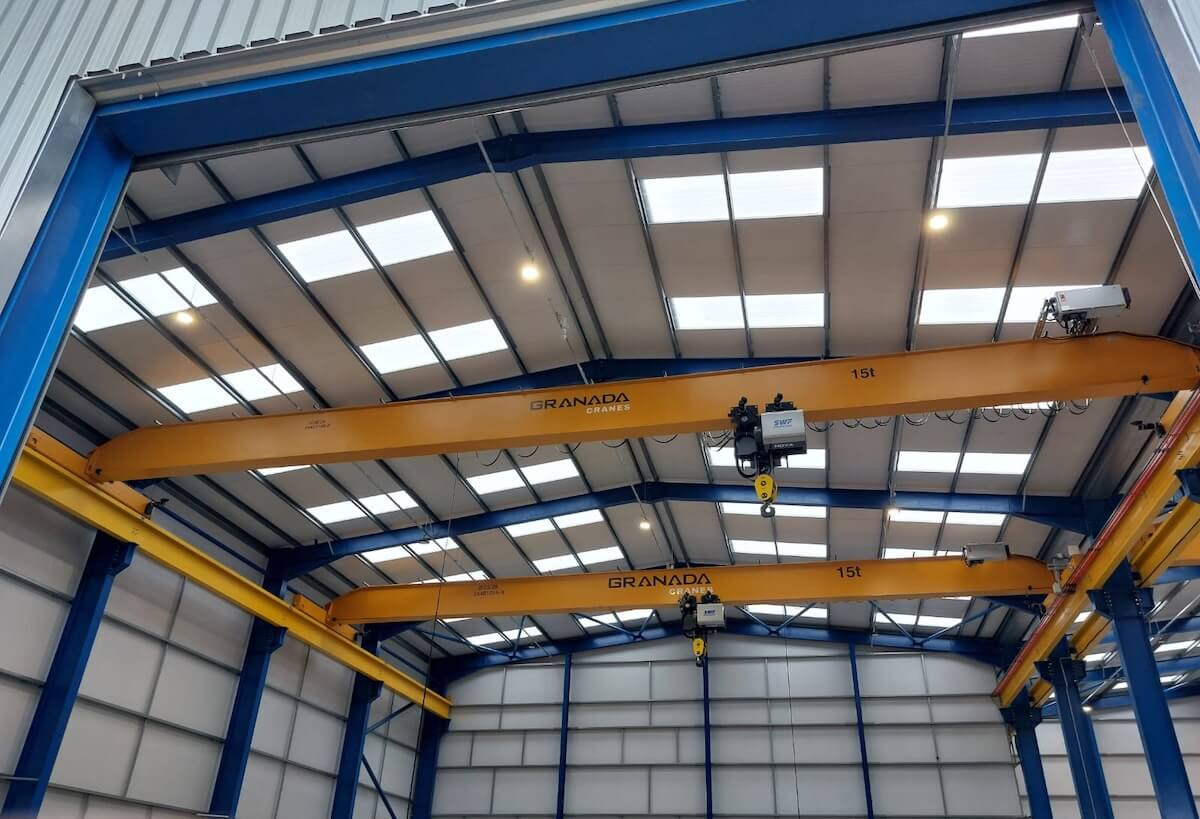
Single girder cranes feature one main bridge beam, with the hoist and trolley running along the bottom flange of the girder. This design makes them lighter, more compact, and more economical than their double girder counterparts.
Advantages
- Lower initial purchase cost
- Lighter weight – less demand on building structure
- Better hook height in buildings with limited headroom
- Faster and simpler installation
- Lower running costs
- Ideal for light to medium duty cycles
Limitations
- Capacity typically limited to 10-15 tonnes
- Span limited to around 20-25 metres
- Less rigid at longer spans
- Not suitable for heavy duty cycles
- Fewer options for auxiliary equipment
Single girder cranes are the most popular choice for general industrial applications. For capacities up to 10 tonnes, they offer excellent value and performance. They’re particularly well-suited to workshops, warehouses, and manufacturing facilities where headroom is limited and loads are moderate.
Double Girder Overhead Cranes
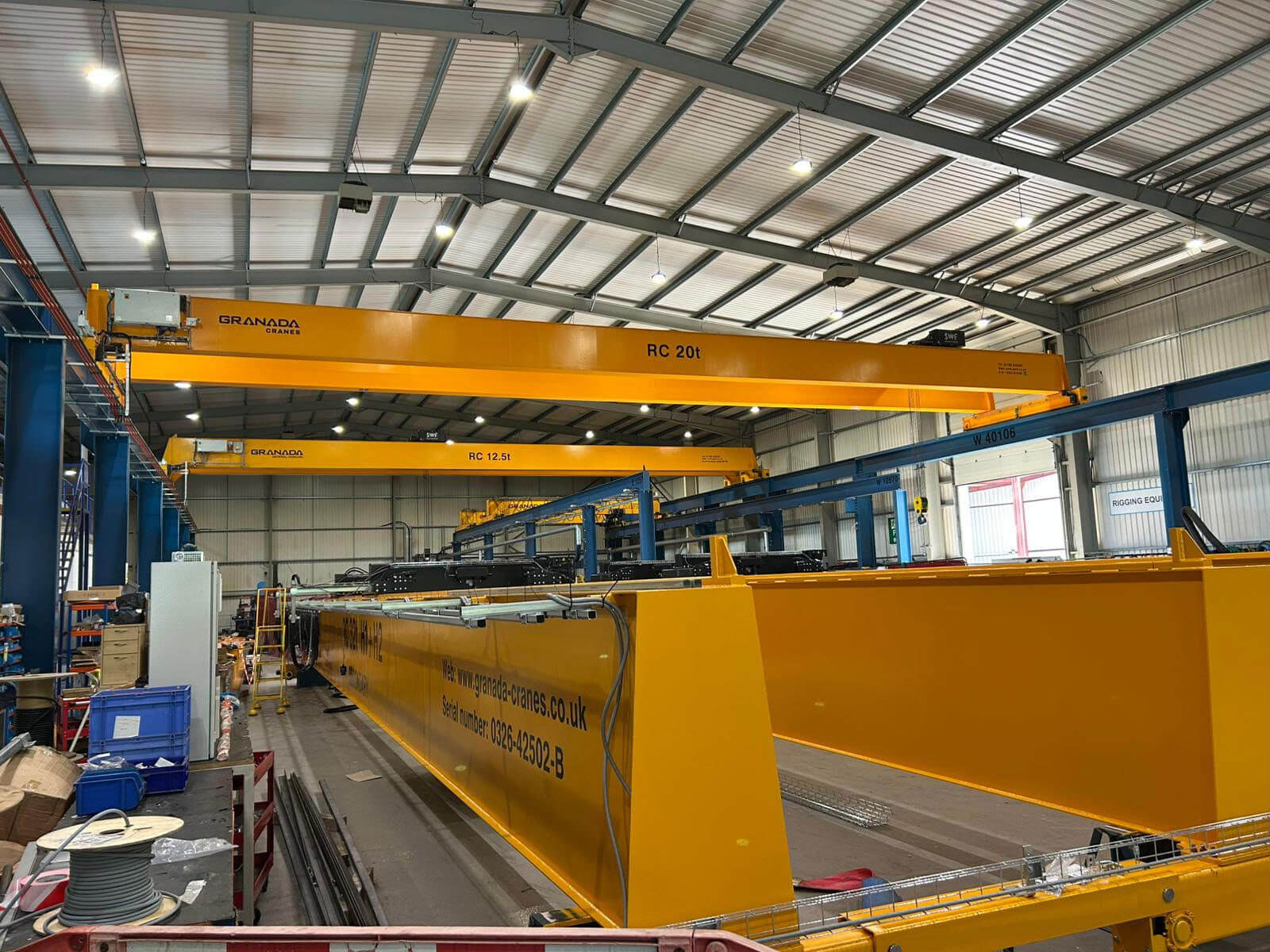
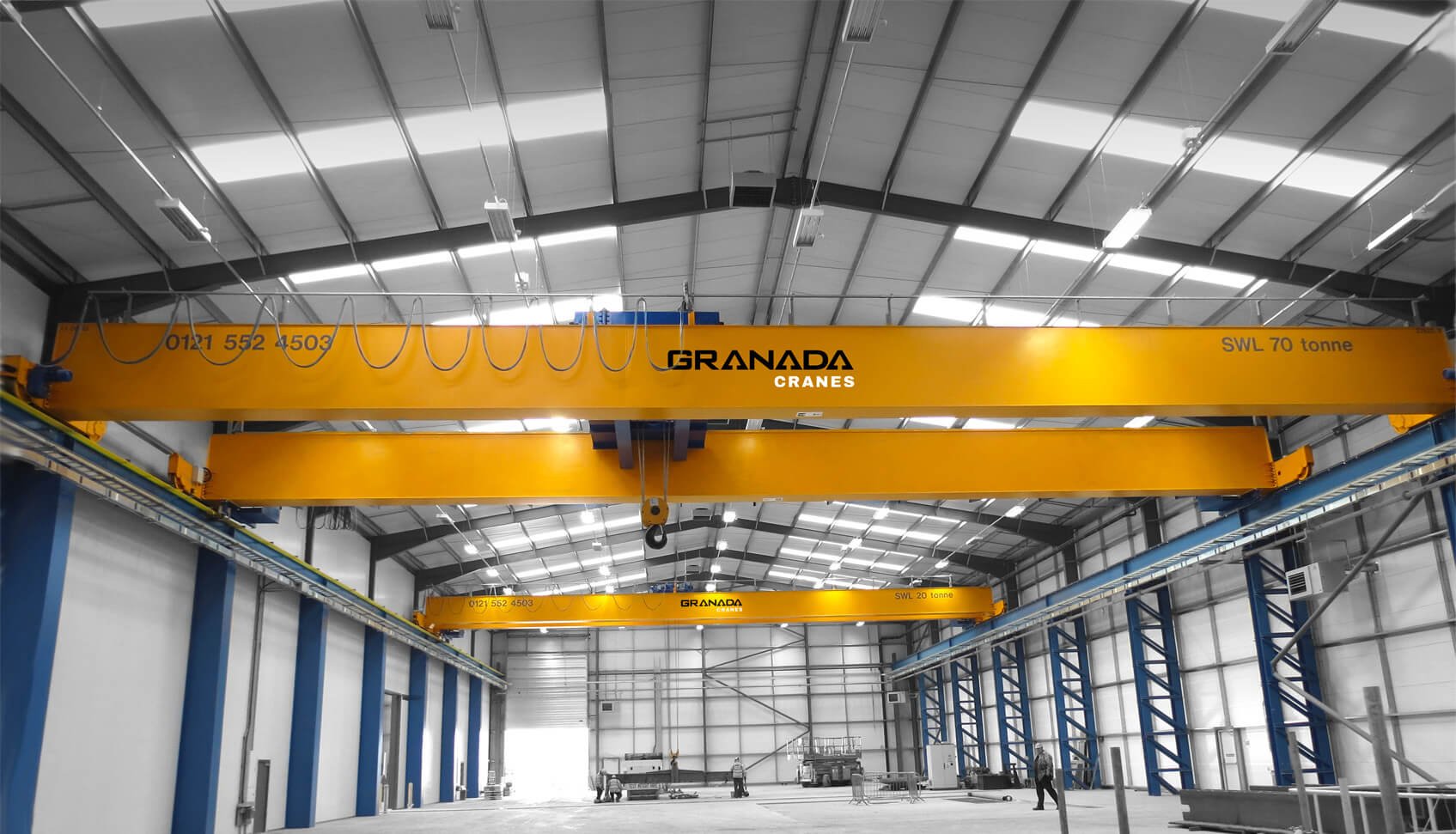
Double girder cranes use two parallel bridge beams with the hoist and trolley mounted on rails on top of the girders. This configuration provides greater strength and rigidity, making them suitable for heavier loads and longer spans.
Advantages
- Higher lifting capacities (up to 60+ tonnes)
- Longer spans possible (30+ metres)
- Greater rigidity and stability
- Better for heavy duty cycles
- More options for accessories and auxiliary hoists
- Maintenance walkways can be fitted on the bridge
Limitations
- Higher initial cost
- Heavier – requires stronger building structure
- Needs more headroom (hoist sits on top of girders)
- More complex installation
- Higher long-term maintenance costs
Double girder cranes are essential for heavy industrial applications. For capacities of 15 tonnes, 20 tonnes, or 30+ tonnes, double girder construction is typically required to handle the loads safely and efficiently.
How to Choose: Decision Guide
Which Girder Type Do You Need?
Choose Single Girder If:
Your maximum load is under 10 tonnes, span is under 20m, headroom is limited, budget is a priority, or duty cycle is light to medium.
Choose Double Girder If:
You need to lift over 15 tonnes, span exceeds 25m, heavy duty cycle is required, you need maintenance walkways, or auxiliary hoists are needed.
The “Grey Area” – 10 to 15 Tonnes
In the 10-15 tonne range, either configuration may work. The choice often comes down to:
- Span length – longer spans favour double girder for rigidity
- Duty cycle – frequent heavy use favours double girder
- Headroom – limited headroom favours single girder
- Budget – cost constraints favour single girder
- Building structure – weaker structures favour lighter single girder
Our team can advise on the best option for your specific situation. Often a site survey is the best way to determine which design suits your building and operational requirements.
Applications by Industry
| Industry | Typical Girder Type | Why |
|---|---|---|
| Warehousing | Single girder | Lighter loads, cost-effective, good hook height |
| Steel Fabrication | Both | Single for lighter work, double for heavy plate/beams |
| Automotive | Single girder | Component handling, moderate loads, production lines |
| Aerospace | Both | Precision work often single; large assemblies need double |
| Steelworks | Double girder | Heavy coils, high duty cycle, demanding environment |
| General Engineering | Single girder | Versatile, cost-effective for most workshop tasks |
| Power Generation | Double girder | Heavy turbines, transformers, long spans |
Cost Comparison
Single girder cranes are typically 20-30% less expensive than equivalent double girder cranes. However, the total cost difference depends on several factors:
- Crane cost – single girder uses less steel and simpler construction
- Building modifications – double girder may require structural reinforcement
- Installation time – single girder is faster to install
- Running costs – lighter single girder uses less power
- Maintenance – simpler single girder design means lower maintenance costs
Important: Don’t Under-Specify to Save Money
While single girder cranes are more economical, choosing one purely to reduce costs when a double girder is needed will lead to problems. Under-specified cranes suffer premature wear, reduced lifespan, and potential safety issues. Always specify based on your actual requirements, not just budget.
Hoist Position: Under-Running vs Top-Running
The girder type determines how the hoist travels:
- Single girder (under-running) – hoist hangs below the girder, trolley runs on the bottom flange. This maximises hook height but limits capacity.
- Double girder (top-running) – hoist sits on top of the girders, trolley runs on rails mounted on the beams. This allows higher capacities and better load stability but requires more headroom.
In buildings with restricted headroom, single girder cranes often provide better hook height because the hoist sits below the beam rather than on top of it.
Safety and Compliance
Both single and double girder cranes must comply with the same safety standards and regulations. All overhead cranes we supply are:
- Designed and manufactured to British and European standards
- Supplied with EC Declaration of Conformity and CE marking
- Subject to LOLER thorough examination before handover
- Equipped with safety features including overload protection, limit switches, and emergency stops
We also provide ongoing servicing and maintenance for both crane types, including LOLER inspections at the required intervals.
Need Help Choosing?
Our team can advise whether a single or double girder crane is right for your application. We’ll consider your loads, building, duty cycle, and budget to recommend the best solution.
Summary
Key Takeaways
- Single girder – best for capacities up to 10t, spans under 20m, limited headroom, and cost-sensitive projects
- Double girder – best for capacities over 15t, spans over 25m, heavy duty cycles, and demanding industrial applications
- 10-15 tonne range – either may work; consider span, duty cycle, headroom, and budget
- Cost – single girder is 20-30% cheaper, but don’t under-specify to save money
- Hook height – single girder often better in restricted headroom
- Both types – must meet the same safety standards and LOLER requirements
The right choice depends on your specific requirements. For most general industrial applications with moderate loads, a single girder crane offers the best combination of performance and value. For heavy lifting, long spans, or demanding duty cycles, double girder construction provides the strength and capability you need.
Explore our full range of overhead gantry cranes from 1 tonne to 60+ tonnes, or contact our team to discuss your requirements.
Introduction:
Welcome to our in-depth exploration of single and double girder overhead cranes. In the industrial world, selecting the right crane is not just a matter of preference, but a critical decision impacting efficiency, safety, and cost. Understanding the differences between these two types of cranes is essential for any business looking to make an informed investment.
Understanding Overhead Cranes:
An overhead crane is a complex machinery used for lifting and moving heavy loads within a fixed area, such as a manufacturing facility or a warehouse. Key components include the bridge (which traverses the workspace), the hoist (which lifts the load), and the trolley (which moves the load along the bridge).
Single Girder Overhead Cranes:
Design Features: Single girder cranes feature one main beam and a trolley hoist that runs along the bottom flange of the beam. They are generally lighter and less complex in design.
Pros:
- Cost-effective and easier to install.
- Suitable for light to medium-duty tasks.
- Ideal for facilities with limited headroom and lighter loads.
Cons:
- Lower lifting capacity, typically up to 15-20 tons.
- Limited in terms of hook height and span.
Double Girder Overhead Cranes:
Design Features: Double girder cranes consist of two main beams with the trolley hoist traveling on rails mounted on top of the beams. They are robust and designed for heavy-duty applications.
Pros:
- Higher lifting capacity, suitable for loads exceeding 20 tons.
- Greater hook height and span capabilities.
- Enhanced stability, ideal for heavy and bulky loads.
Cons:
- Higher initial investment and installation complexity.
- Requires more headroom in the facility.
Key Factors to Consider:
Lifting Capacity: Single girders are apt for lighter loads, while double girders excel in handling heavier weights.
Span and Lifting Height: Single girder cranes are optimal for shorter spans and lower lifting heights, whereas double girders can accommodate larger spans and greater lifting heights.
Working Environment: The choice should align with the operational demands of your workspace, considering factors like ceiling height and floor space.
Cost Implications:
Initial Investment: Single girder cranes are more budget-friendly initially, but double girder cranes offer better long-term value for more demanding operations.
Maintenance Costs: Both types require regular maintenance, but the complexity of double girder cranes might lead to slightly higher long-term costs.
Safety and Compliance:
Both crane types are designed with safety as a priority, equipped with features like overload protection and emergency stops. They adhere to rigorous industry standards, ensuring operational safety and compliance.
Case Studies / Real-World Applications:
From automotive assembly lines using single girder cranes for their compact spaces to heavy manufacturing plants relying on double girder cranes for their robust lifting capacity, these cranes have proven their worth across diverse industries.
Conclusion:
Choosing between a single and a double girder crane ultimately depends on your specific operational needs, budget, and space constraints. By understanding the nuances of each, you can make a choice that not only elevates your operational efficiency but also aligns with your strategic objectives.
For further guidance or to discuss your overhead crane requirements, don’t hesitate to contact our team of experts at Granada Cranes. We’re here to provide tailored solutions that meet your specific lifting needs. Explore more on our website or reach out to us directly for personalized assistance.
The advice, graphics, images, and information provided herein are for general educational and informational purposes only and are intended to promote overall safety awareness. They do not constitute legal, medical, or other professional advice or services and should not be relied upon as a substitute for consultation with suitably qualified professionals. The content is not intended to be comprehensive, and users should seek independent professional advice appropriate to their specific circumstances.