Cranes for Aerospace Manufacturing

Aerospace manufacturing demands the highest levels of precision, cleanliness, and safety from every piece of equipment on the factory floor. The cranes that lift aircraft engines weighing 8 tonnes, position composite wing panels worth hundreds of thousands of pounds, and manoeuvre fuselage sections through assembly lines must meet standards that simply don’t apply in other industries. This guide covers the specialist crane requirements for aerospace and aircraft manufacturing facilities.
Why Aerospace Manufacturing Requires Specialist Cranes
An aircraft factory isn’t like a typical manufacturing facility. The components being handled represent enormous financial investments – a single jet engine can cost upwards of £10 million, while composite wing skins run into hundreds of thousands of pounds. Beyond the financial stakes, aerospace manufacturing operates under strict regulatory oversight where material handling incidents can ground entire production lines.
Standard industrial cranes simply cannot meet aerospace requirements. The sector demands:
- Precision positioning – components must be placed with millimetre accuracy for assembly operations
- Controlled motion – sudden movements or load sway can damage delicate composites or precision-machined surfaces
- Contamination control – Foreign Object Debris (FOD) prevention is critical throughout production
- Traceability – lifting operations often require documentation for quality records
- Integration – cranes frequently form part of automated assembly systems
Granada Cranes in Aerospace
We’re proud to be a trusted partner for leading aerospace manufacturers, providing bespoke industrial lifting solutions that meet the exacting standards of aircraft production. Our cranes support operations from component manufacturing through to final assembly.
What You’ll Be Lifting: Aircraft Component Weights
Understanding the weight range of aerospace components is the starting point for crane specification. Aircraft parts vary dramatically – from small avionics units to complete fuselage sections – but several key components drive capacity requirements.
Widebody Jet Engines
Rolls-Royce Trent XWB, GE90, CF6-80 series
Narrowbody Jet Engines
CFM56, LEAP, V2500 series
Wing Assemblies
Complete wing structures with control surfaces
Fuselage Sections
Barrel sections for assembly joining
Landing Gear Assemblies
Main and nose gear complete units
Composite Panels
Wing skins, fairings, control surfaces
While individual component weights determine minimum capacity, always factor in lifting attachments (spreader beams, cradles, vacuum systems) which can add 500–2,000 kg. Most aerospace facilities specify cranes at 1.5–2× the heaviest single component to accommodate tooling and provide headroom for future requirements.
Crane Types for Aerospace Facilities
Aerospace manufacturing typically employs a combination of crane types, each suited to different operations within the production workflow.
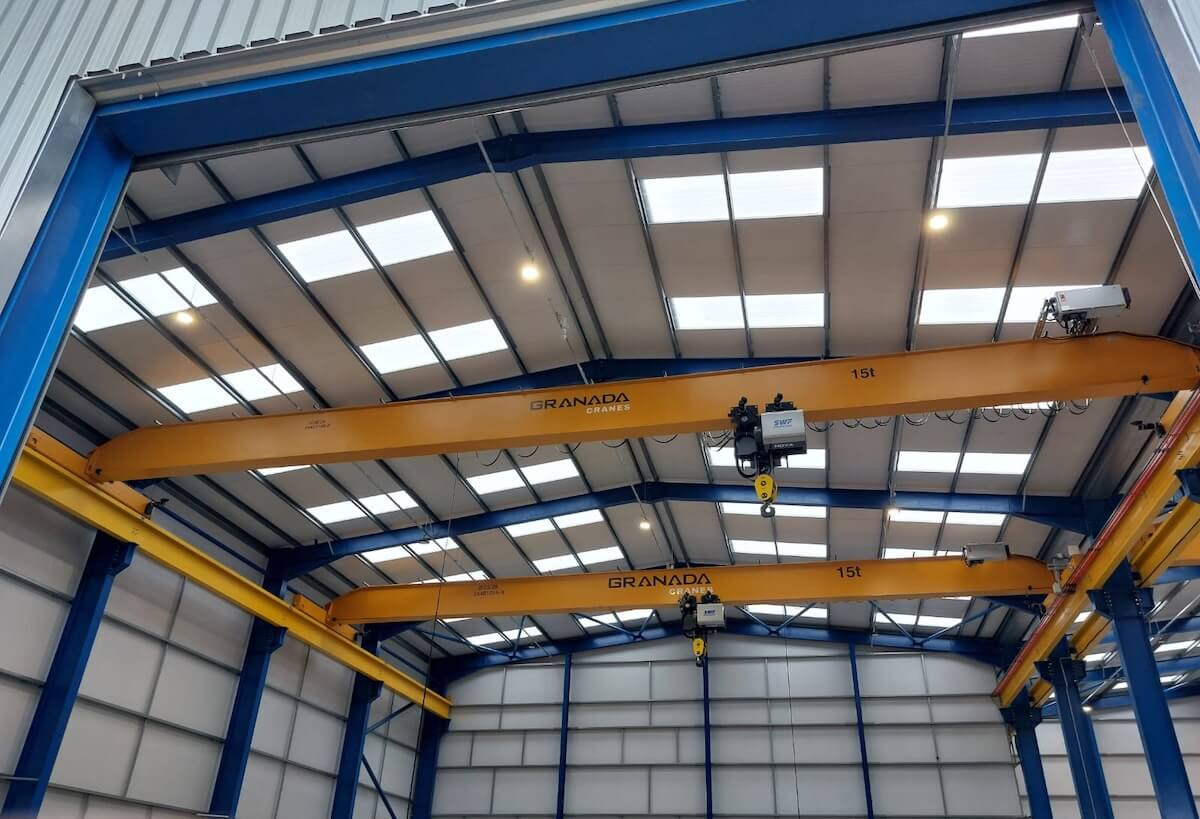
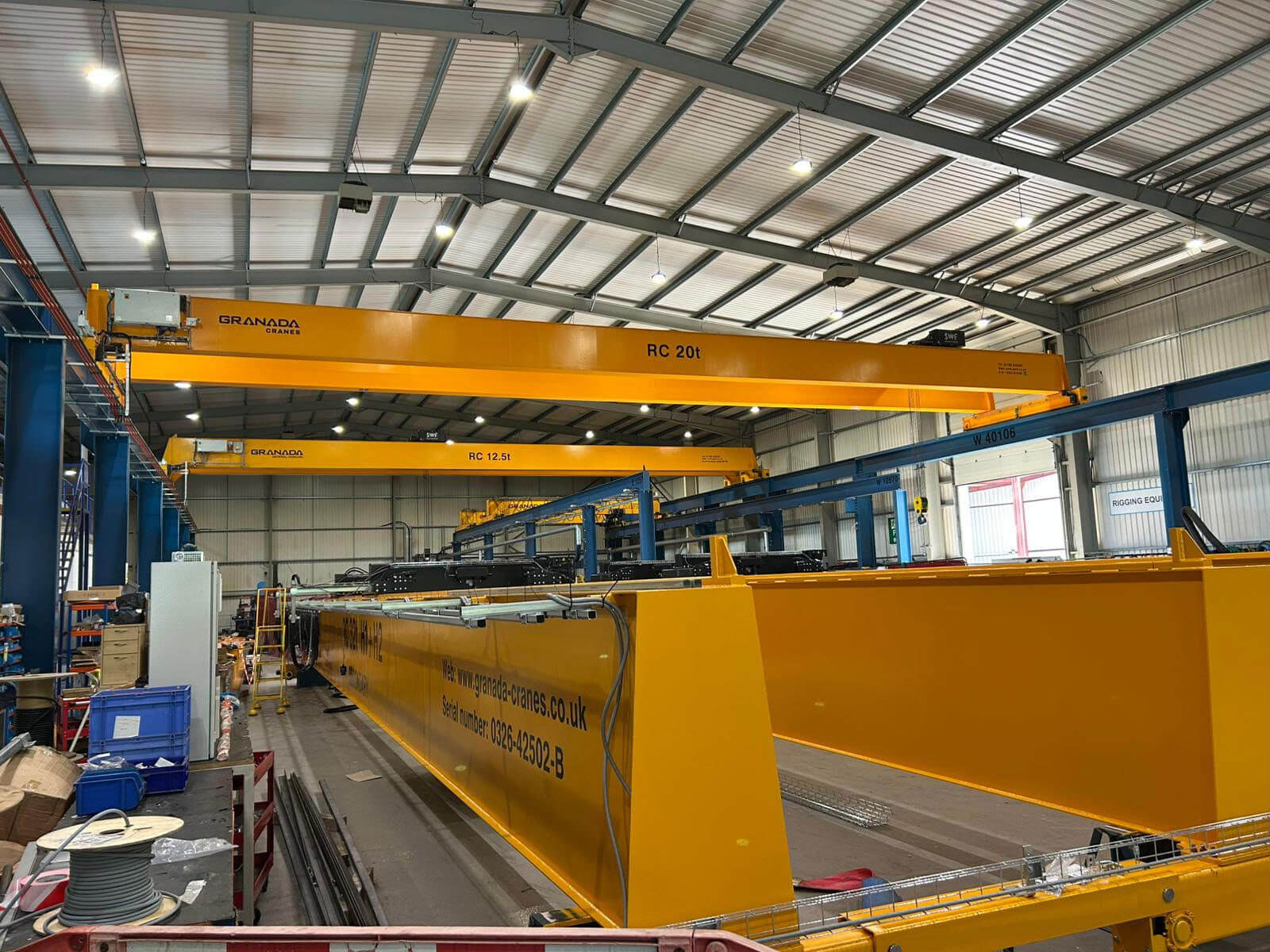
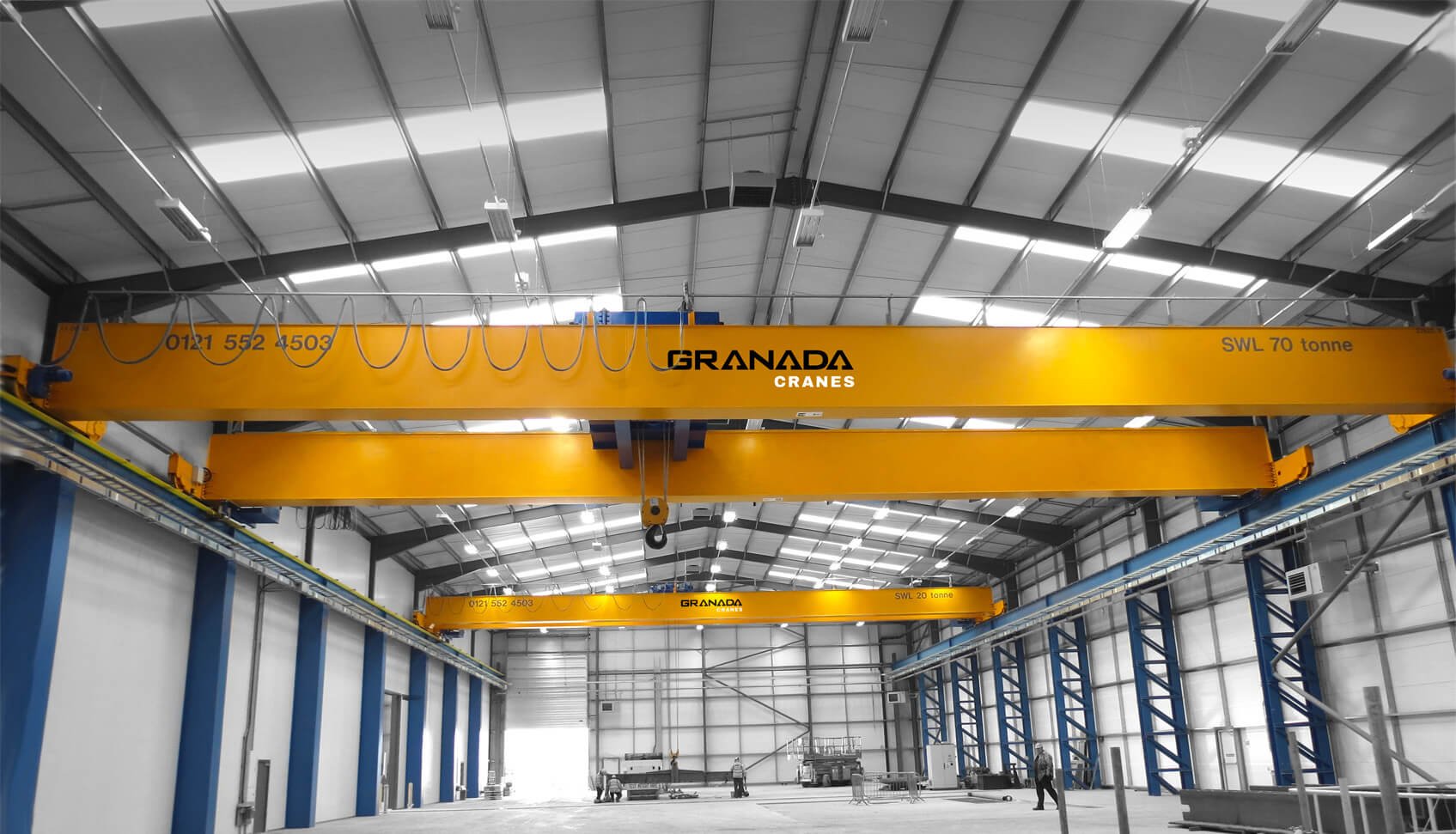
Double Girder Overhead Crane
The workhorse of aerospace assembly halls. Double girder configurations provide the stability, precision, and hook height required for handling large aircraft components. These cranes typically span 20–50+ metres across assembly bays and incorporate advanced motion control systems.
- Capacity range: 5–50 tonnes (10–20 tonnes most common)
- Spans up to 100+ metres available for aircraft final assembly
- Often configured with dual hoists for tandem lifting
- VFD control with micro-speed positioning standard
Single Girder Overhead Crane
Used in smaller production cells, machining areas, and parts storage zones where lighter loads and shorter spans are typical. Single girder cranes offer a cost-effective solution for facilities handling components rather than major assemblies.
- Capacity range: 1–10 tonnes typical
- Suitable for spans up to 25 metres
- Lower headroom requirements than double girder
- Good choice for tooling and fixture handling
Swing Jib Cranes
Essential for providing operators with local lifting capability at specific work positions. Jib cranes handle smaller components, tooling, and lifting aids without requiring the main overhead crane. They’re particularly valuable at final assembly stations and in maintenance areas.
- Capacity range: 125 kg–2 tonnes typical
- 270° or 360° rotation options
- Floor-mounted or column-mounted configurations
- Ideal for cockpit instrument installation, fastener handling
Gantry & Semi-Goliath Cranes
Used where building structure cannot support overhead runway loads, or in outdoor storage and delivery areas. Semi-goliath designs (one end on floor rails, one on elevated runway) offer flexibility for production layout changes.
- Capacity range: 5–50+ tonnes
- Independent of building structure
- Can be designed for outdoor operation with weather protection
- Good for raw material handling and delivery bays
Lightweight Crane Systems
Aluminium rail systems and enclosed track provide smooth, low-effort handling for lighter components. These systems are particularly suited to cleanroom environments where minimal contamination is essential, such as composite layup areas and avionics assembly.
- Capacity range: up to 2 tonnes
- Near-effortless manual or powered operation
- Enclosed track designs prevent debris falling
- Excellent for repetitive handling tasks
Critical Features for Aerospace Cranes
Beyond basic lifting capability, aerospace cranes require specific features that address the unique demands of aircraft manufacturing.
Precision Motion Control
Aircraft assembly requires positioning accuracy that standard industrial cranes cannot achieve. Modern aerospace cranes incorporate several technologies to deliver precision handling:
Variable Frequency Drives
VFDs provide stepless speed control for smooth acceleration and deceleration, eliminating the jerky motion of contactor-controlled drives
Micro-Speed Control
Ultra-low speeds (as low as 1% of full speed) for final positioning, allowing operators to make millimetre-level adjustments
Anti-Sway Systems
Electronic systems that predict and counteract load swing, reducing sway by up to 95% for safer, faster positioning
Load-Dependent Speed
Systems that automatically adjust lifting speed based on load weight, ensuring consistent handling regardless of component mass
| Control Feature | Purpose | Typical Specification |
|---|---|---|
| Positioning accuracy | Precise component placement | ±2mm or better |
| Anti-sway reduction | Load stability during movement | 85–95% sway reduction |
| Micro-speed percentage | Fine positioning control | 1–5% of max speed |
| Speed range ratio | Flexibility between rapid transit and slow positioning | 100:1 typical |
FOD Prevention and Cleanroom Compatibility
Foreign Object Debris (FOD) is one of aerospace manufacturing’s most serious concerns. A dropped bolt, a flake of paint, or debris from crane components can cause catastrophic damage to engines, create assembly defects, or compromise aircraft safety. Cranes must be designed to prevent contamination.
Aerospace components and engines are highly susceptible to premature failure if contaminated during manufacture. FOD prevention isn’t just good practice – it’s a fundamental requirement that influences every aspect of crane specification, from materials to maintenance procedures.
FOD-prevention features for aerospace cranes include:
For composite manufacturing areas, cleanroom-rated cranes may be required. These are validated against ISO cleanroom classifications using laser particle counters to verify contamination levels during operation.
Safety Systems
Aerospace facilities require comprehensive safety features beyond standard industrial requirements:
- Overload protection – prevents lifting beyond rated capacity (typically limits to 110% with alarm, cuts at 125%)
- Collision avoidance – zone limiting and anti-collision systems where multiple cranes share runways
- End-of-travel limits – prevent crane from overrunning runway ends or trolley limits
- Emergency stop systems – accessible e-stops with fail-safe design
- Redundant braking – dual brake systems on critical hoists for safety-critical lifts
- Load monitoring – continuous display of load weight with recording capability
Lifting Attachments and Below-the-Hook Equipment
The crane itself is only part of the lifting system. Aerospace components require specialist attachments designed to protect high-value parts during handling.
Spreader Beams & Lifting Frames
- Multi-point lifting for long or awkward components
- Bespoke designs for specific aircraft parts
- Adjustable designs for product families
- Load distribution across fragile structures
- Often designed with component cradles integrated
Vacuum Lifting Systems
- Ideal for composite panels and skins
- No surface marking or damage to finished parts
- Quick attachment and release
- Multiple pad configurations for different geometries
- Battery backup for safety during power loss
Engine Stands & Cradles
- Purpose-designed for specific engine types
- Rotatable designs for maintenance access
- Integration with transport dollies
- Protection for sensitive engine surfaces
- Typically supplied by engine OEMs
Soft Slings & Protective Straps
- Textile slings for finished surface protection
- Wide bearing surfaces to prevent marking
- Colour-coded for capacity identification
- Regular inspection requirements
- Used with protective sleeving over sharp edges
In aerospace, all lifting attachments must be traceable with documented inspection histories. Below-the-hook equipment requires its own thorough examination regime – typically every 6 months under LOLER. Many aerospace facilities maintain detailed logs of which attachments were used for each lift operation.
Automation and Integration
Modern aerospace manufacturing increasingly relies on automated systems, and cranes must integrate seamlessly into these workflows.
Automated Positioning
Cranes can be programmed with position memory for repetitive operations, moving automatically to preset coordinates. This is particularly valuable in production lines where components must be positioned at the same location repeatedly – for example, lowering fuselage sections onto assembly jigs.
System Integration
Aerospace cranes often connect to:
- Production control systems – receiving instructions for component moves as part of manufacturing sequence
- Automated assembly lines – coordinating with robotic systems, conveyors, and AGVs
- Quality systems – logging lift data for component traceability
- Maintenance systems – reporting operating hours and triggering service alerts
Remote and Centralised Control
Beyond standard radio remote controls, aerospace facilities may employ:
- Control room operation for complex multi-crane moves
- CCTV integration for blind spot monitoring
- Tandem lift coordination for large assemblies
- Condition monitoring with real-time performance data
Specification Considerations
When specifying cranes for aerospace manufacturing, these factors require particular attention:
Capacity & Configuration
Define maximum component weights plus attachments. Consider whether dual hoists for tandem lifting are needed. Account for future aircraft programmes that may require different capacities.
Speed & Precision Requirements
Balance throughput (rapid transit speeds) against positioning needs (micro-speeds). Specify anti-sway requirements based on load characteristics and operator skill levels.
Environment & Contamination Control
Identify cleanroom requirements and ISO classifications. Specify FOD prevention features appropriate to production area criticality.
Integration Requirements
Define interfaces with production systems, automation equipment, and existing cranes. Establish data requirements for quality and maintenance tracking.
Duty Cycle & Service Life
Aerospace production operates on long programme cycles. Specify FEM duty classifications (typically M5–M6) that support decades of reliable operation with appropriate maintenance intervals.
UK Compliance Requirements
Aerospace manufacturing facilities in the UK must meet the same lifting equipment regulations as other industries, though often with additional internal standards:
- LOLER 1998 – Thorough examination every 12 months for the crane, every 6 months for lifting accessories
- PUWER 1998 – Ongoing maintenance obligations and safe systems of work
- BS 7121 – Code of practice for safe use of cranes
- Additional aerospace-specific standards may apply depending on customer requirements and certification bodies
Many aerospace facilities impose requirements beyond statutory minimums, including more frequent inspections, enhanced documentation, and specific competency requirements for crane operators.
Frequently Asked Questions
Aerospace Lifting Solutions
From component manufacturing through to final assembly, we design crane systems that meet aerospace’s exacting standards.
The advice, graphics, images, and information provided herein are for general educational and informational purposes only and are intended to promote overall safety awareness. They do not constitute legal, medical, or other professional advice or services and should not be relied upon as a substitute for consultation with suitably qualified professionals. The content is not intended to be comprehensive, and users should seek independent professional advice appropriate to their specific circumstances.