Choosing a Crane for Timber and Sawmill Operations

Timber and sawmill operations present unique material handling challenges. Long lengths, varying weights, rough surfaces, and the need for precision positioning all demand carefully specified crane systems. Whether you’re handling raw logs, processed timber, or manufactured panels, the right crane setup transforms productivity and safety.
At Granada Cranes, we’ve designed and installed crane systems for timber businesses across the UK – from traditional sawmills to modern timber frame manufacturers. This guide explains what to consider when choosing cranes for timber operations.
Material Handling Challenges in Timber Operations
Timber businesses handle a wide variety of materials, each with different handling requirements:
Raw Logs
Heavy, irregular shapes requiring secure gripping. Outdoor storage and transport to processing lines.
Sawn Timber & Beams
Long lengths needing balanced lifting. Movement between sawing, treatment, and storage areas.
Sheet Materials
OSB, plywood, MDF panels. Large surface areas requiring careful handling to prevent damage.
Timber Frame Panels
Prefabricated wall and roof sections. Precise positioning at assembly stations and for loading.
Glulam & CLT
Engineered timber products. Heavy, high-value items requiring careful, damage-free handling.
Finished Products
Doors, windows, furniture components. Often requires gentle handling of finished surfaces.
The diversity of materials often means timber operations need multiple crane systems working together – overhead cranes for heavy lifting, jib cranes at workstations, and specialised lifting attachments for different product types.
Types of Crane for Timber Operations
Different areas of a timber facility typically require different crane solutions:
Most Versatile
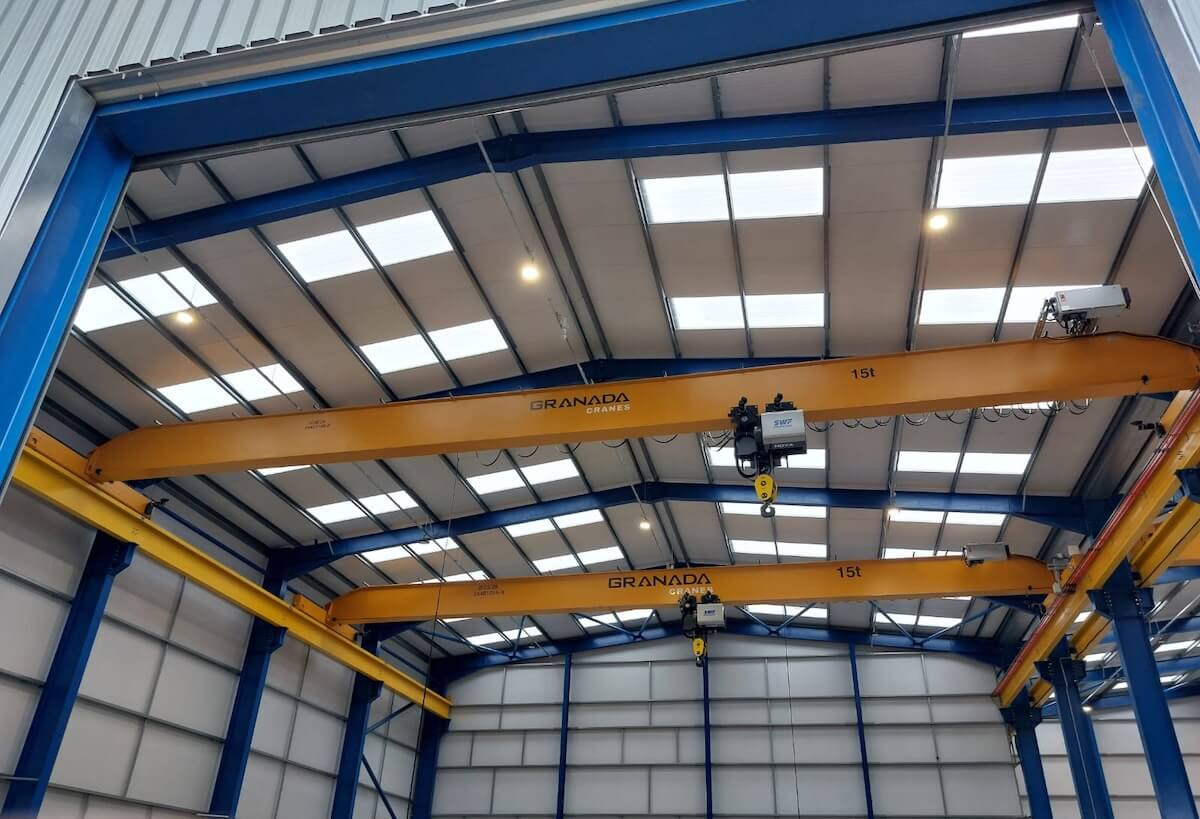
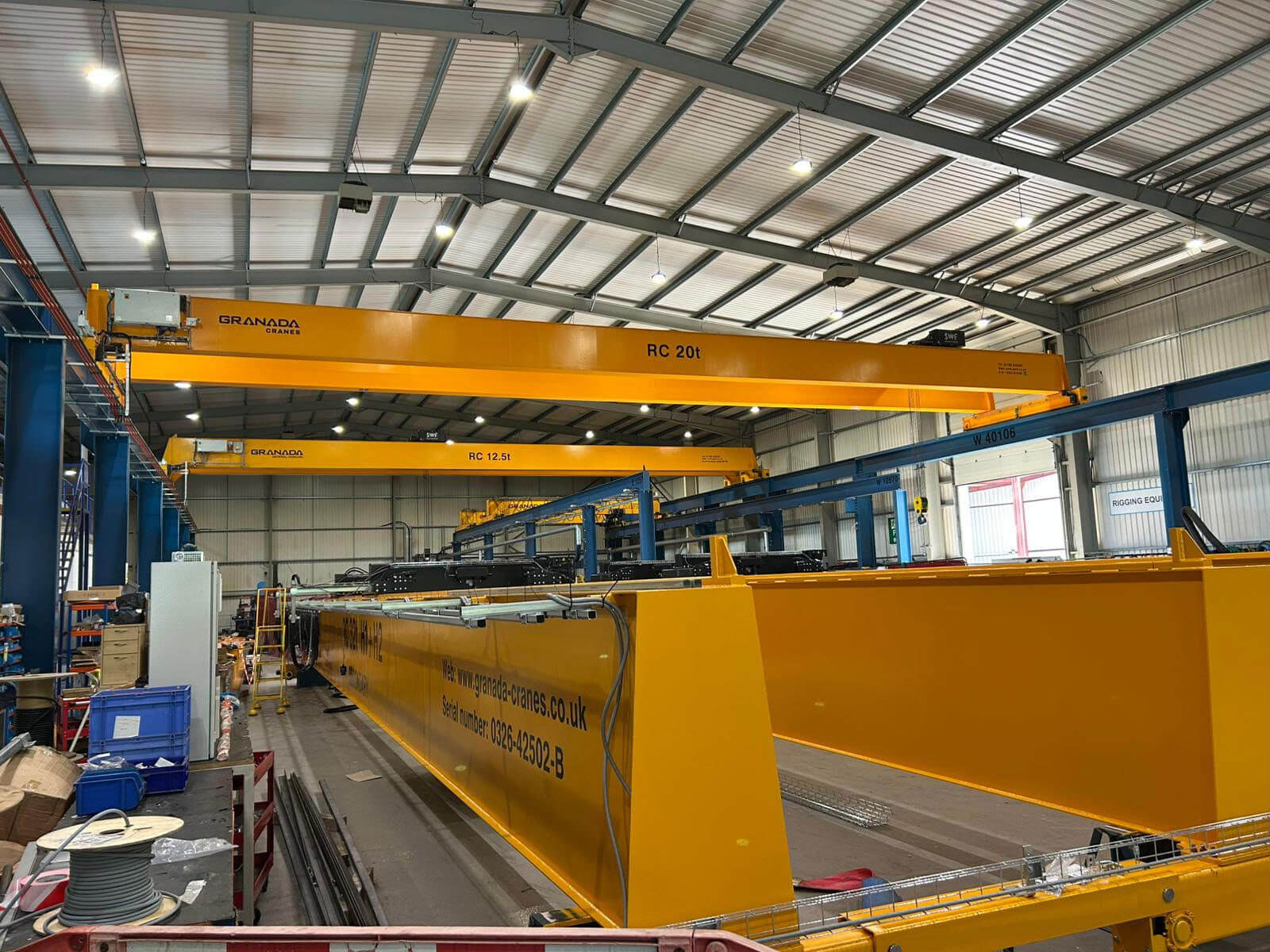
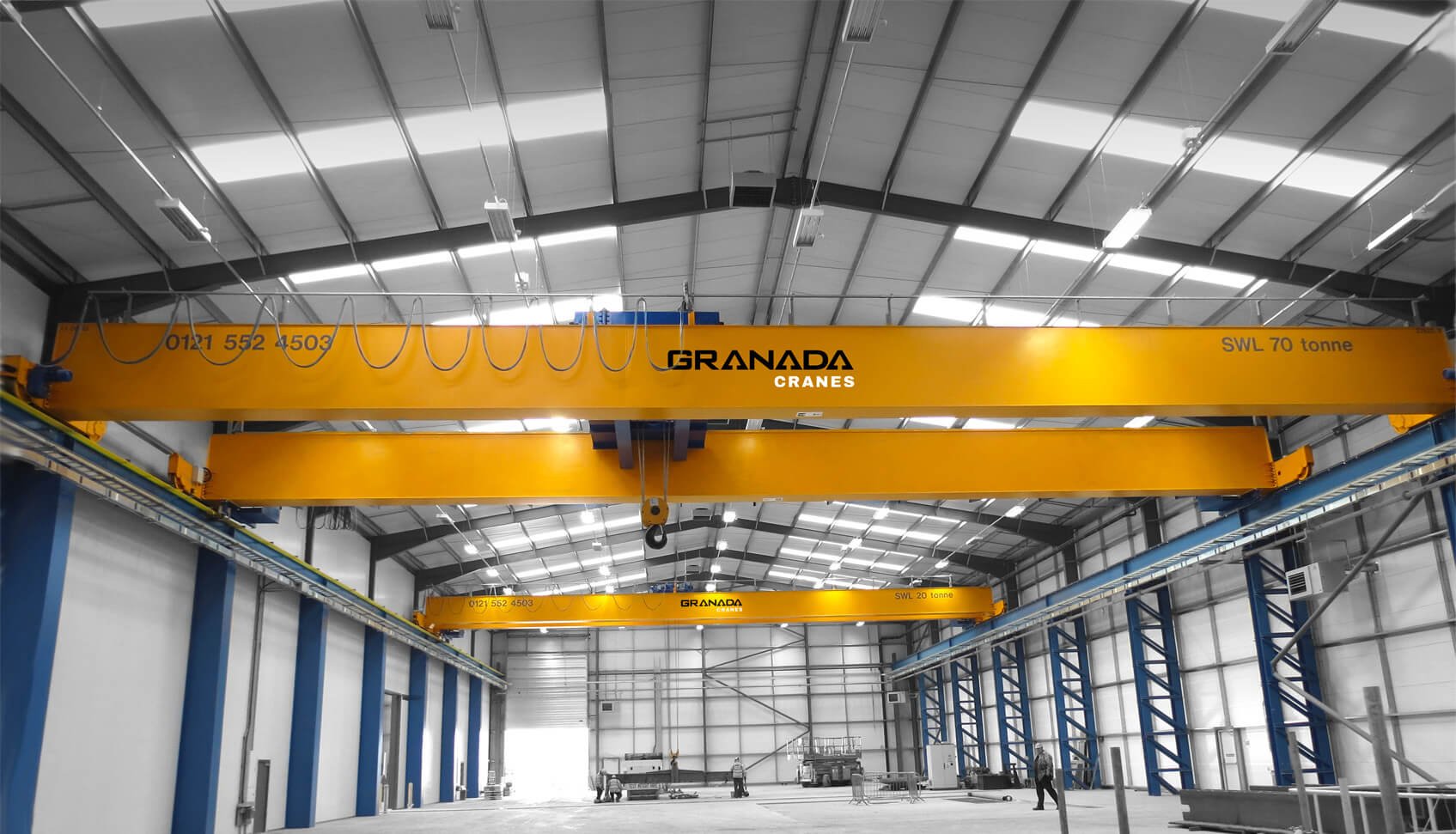
The workhorse of most timber facilities. Overhead gantry cranes provide full coverage of production areas, allowing materials to be moved anywhere within the crane’s span. Ideal for main production halls, assembly areas, and loading bays.
Single girder designs suit lighter loads and smaller spans; double girder configurations handle heavier timber and provide better hook height in tall buildings.
2–20 tonnes
Production halls, assembly
Full floor area
Vacuum lifters, slings
Freestanding and wall-mounted jib cranes provide dedicated lifting at individual workstations. They’re ideal for loading CNC machines, assembly tables, and packaging stations where operators need quick, localised lifting without waiting for the main overhead crane.
Jib cranes work excellently with vacuum lifters for handling sheet materials and panels at individual work cells.
125kg–2 tonnes
Workstations, CNC loading
270°–360° rotation
Vacuum lifters, hoists
Aluminium rail systems and enclosed track cranes offer smooth, low-friction movement for lighter loads. They’re particularly suited to ergonomic handling applications where operators manually guide loads – common in joinery, furniture production, and panel handling.
These systems integrate seamlessly with vacuum lifters and are designed for high-frequency, low-weight applications.
Up to 2 tonnes
Panel handling, joinery
Defined work areas
Ergonomic operation
For outdoor timber yards and log storage areas, floor-mounted gantry cranes provide heavy lifting without requiring building-mounted runways. They’re common in sawmills for handling logs and in timber yards for stacking and retrieval.
Can be equipped with timber grabs or grapples for handling loose logs and bundles.
5–50+ tonnes
Log yards, outdoor storage
Large outdoor areas
Log grabs, grapples
Case Study: Oregon Timber Frame
In early 2023, Granada Cranes completed a comprehensive material handling installation for Oregon Timber Frame’s new factory. The project included 11 overhead gantry cranes, multiple freestanding jib cranes, vacuum powerlifting systems, and lightweight crane systems – all delivered within a strict six-month timeframe.
Working closely with Oregon Timber Frame, we customised each element to fit their specific operational needs. The combination of overhead cranes for heavy lifting, jib cranes at assembly stations, and vacuum systems for panel handling created an integrated solution covering the entire production process.
Granada Cranes continues to support the facility with an ongoing maintenance contract, ensuring all equipment remains compliant and operational.
Lifting Attachments for Timber
The crane is only part of the solution – the lifting attachments you use are equally important. Timber operations typically require several different attachment types:
Vacuum Lifting Systems
Essential for handling sheet materials, panels, and timber frame components without damage. Vacuum lifters grip the surface securely and release instantly.
- Ideal for OSB, plywood, MDF panels
- Handles timber frame wall sections
- No marking or damage to surfaces
- Single operator can handle large panels
- Often mounted on jib cranes or lightweight systems
Timber Grabs & Grapples
For handling logs, bundles, and rough timber. Mechanical, hydraulic, or electro-hydraulic options available depending on application.
- Secure grip on irregular log shapes
- Can handle multiple logs simultaneously
- Suited to outdoor gantry cranes
- Various sizes for different log diameters
- Robust construction for demanding use
Slings & Straps
Versatile solution for sawn timber, beams, and packaged products. Roundslings protect finished surfaces from marking.
- Webbing slings for finished timber
- Chain slings for heavy beams
- Roundslings prevent surface damage
- Adjustable for different load sizes
- Regular 6-monthly LOLER inspection required
Spreader Beams & Lifting Frames
For long timber lengths and large panel assemblies where multiple pick points are needed to prevent bending or damage.
- Distributes load across multiple points
- Prevents bending of long timber
- Custom designs for specific products
- Can incorporate vacuum pads
- Essential for large timber frame panels
Vacuum lifting systems have transformed timber panel handling. A single operator can safely lift and position large sheet materials that would otherwise require two or three people. They’re particularly valuable for loading CNC machines, assembly tables, and stacking operations – and they eliminate surface damage from chains or clamps.
Capacity Considerations
Timber can be surprisingly heavy, especially when wet or in large sections. Here are typical weights to consider:
| Material | Typical Weight | Notes |
|---|---|---|
| Softwood log (6m × 400mm dia.) | ~600 kg | Fresh cut; varies by species and moisture |
| Hardwood log (6m × 400mm dia.) | ~900 kg | Oak, ash significantly heavier than softwood |
| Glulam beam (12m × 200 × 600mm) | ~700 kg | Engineered timber; consistent density |
| CLT panel (3m × 8m × 120mm) | ~1,400 kg | Cross-laminated timber; very heavy |
| OSB sheet (2.4m × 1.2m × 18mm) | ~30 kg | Light but awkward to handle manually |
| Timber frame wall panel (3m × 2.4m) | 150–400 kg | Varies significantly by specification |
| Roof cassette (6m × 1.2m) | 200–500 kg | Depends on insulation and finish |
When specifying crane capacity, remember to add the weight of your lifting attachments. A vacuum lifting beam might weigh 50–150kg; a timber grab considerably more.
Freshly felled timber contains significant moisture and can weigh 50–100% more than kiln-dried material. If you’re handling both green and dried timber, specify your crane capacity based on the heaviest (wettest) loads you’ll encounter.
Planning a Multi-Crane Installation
Timber facilities often require multiple cranes working together. Here’s how to approach the planning:
- Map your material flow
Trace how materials move through your facility – from goods-in through each processing stage to dispatch. Identify where lifting is required and what’s being lifted at each point. - Identify lifting frequency and weight at each station
High-frequency, light lifting (e.g., loading panels into a CNC) suits jib cranes with vacuum lifters. Heavy, occasional lifts (e.g., moving large assemblies) need overhead crane coverage. - Consider operator workflow
Operators shouldn’t have to wait for cranes. Dedicated jib cranes at workstations keep production moving even when the main overhead crane is in use elsewhere. - Plan for expansion
Timber businesses often grow. Consider whether your crane runways can accommodate additional cranes, and whether your building structure has capacity for future upgrades. - Integrate vacuum and conventional lifting
Panel handling typically suits vacuum systems; structural timber and heavy beams need conventional hoists with slings or grabs. Many facilities need both.
Environmental Considerations
Timber facilities can present challenging environments for crane equipment:
- Dust: Sawdust and wood particles can accumulate in electrical components and moving parts. Enclosed hoist designs and appropriate IP ratings help protect equipment.
- Outdoor exposure: Log yards and external storage areas require weatherproof cranes with corrosion protection.
- Temperature variation: Unheated production sheds experience significant temperature swings. Lubricants and electrical components should be specified accordingly.
- Fire risk: Wood processing carries fire risk. Consider crane positioning relative to fire suppression systems and emergency access routes.
UK Compliance for Timber Operations
All lifting equipment in UK timber facilities must comply with:
- LOLER – Lifting Operations and Lifting Equipment Regulations 1998. Thorough examination every 12 months for cranes; every 6 months for lifting accessories (slings, grabs, vacuum cups).
- PUWER – Provision and Use of Work Equipment Regulations 1998. Equipment must be suitable, maintained, and used only by trained operators.
- Manual Handling Regulations – Particularly relevant for timber operations where ergonomic lifting solutions (vacuum lifters, etc.) reduce manual handling risks.
Granada Cranes provides full LOLER examination services and can set up maintenance contracts to ensure ongoing compliance.
From single jib cranes to complete multi-crane installations, we can design a material handling solution tailored to your timber business.
Or call us on 0800 376 27 27
Frequently Asked Questions
Most timber frame operations work effectively with overhead cranes in the 2–5 tonne range. Wall panels and roof cassettes typically weigh 150–500kg, but you need capacity for heavier items and lifting equipment weight. We’d recommend discussing your specific products with us to determine the right specification.
Vacuum lifters work excellently on smooth, sealed surfaces like plywood, OSB, and finished panels. They’re less effective on rough-sawn timber, very porous materials, or surfaces with large gaps. For rough timber, slings or grabs are typically more appropriate. Many timber facilities use both systems for different product types.
It depends on your facility layout and workflow. Many timber operations benefit from one or more overhead cranes for main production areas, plus dedicated jib cranes at individual workstations. This prevents bottlenecks where operators wait for the main crane. We can survey your facility and recommend the optimal configuration.
Usually, yes. We can mount cranes on existing steel structures (if adequate) or install free-standing systems with independent columns. Timber portal frame buildings may require structural assessment – we work with structural engineers to determine what’s feasible and specify any reinforcement needed.
Dusty environments mean more frequent cleaning and inspection of electrical components. We typically recommend 6–12 monthly service visits depending on usage, plus the statutory LOLER examinations. Vacuum systems require regular checking of seals and suction cups. We offer maintenance contracts covering all equipment types.
Yes. We supply vacuum powerlifting systems as part of complete crane installations, as we did for Oregon Timber Frame. These integrate with jib cranes, lightweight crane systems, or overhead cranes depending on your application.
The advice, graphics, images, and information provided herein are for general educational and informational purposes only and are intended to promote overall safety awareness. They do not constitute legal, medical, or other professional advice or services and should not be relied upon as a substitute for consultation with suitably qualified professionals. The content is not intended to be comprehensive, and users should seek independent professional advice appropriate to their specific circumstances.