How Often Should an Overhead Crane Be Serviced?
One of the most common questions we receive at Granada Cranes is about service frequency. How often should you service your overhead crane? What’s the legal minimum? And what do we actually recommend for safe, reliable operation?
The answer depends on several factors – but let’s start with the essentials you need to know.
Keep reading to understand the difference between legal requirements and best practice maintenance.
Understanding the Legal Requirements
In the UK, overhead crane maintenance and inspection is governed primarily by two regulations:
- LOLER – Lifting Operations and Lifting Equipment Regulations 1998
- PUWER – Provision and Use of Work Equipment Regulations 1998
LOLER sets out the requirements for thorough examination of lifting equipment, while PUWER requires that all work equipment is maintained in safe working order. Together, they establish your legal obligations as an employer or equipment owner.
LOLER Thorough Examination Requirements
| Equipment Type | Examination Frequency | Examples |
|---|---|---|
| Lifting equipment (not for lifting people) | Every 12 months | Overhead cranes, hoists, runway beams |
| Lifting accessories | Every 6 months | Chain slings, wire rope slings, shackles, hooks, eyebolts, lifting beams |
| Equipment for lifting people | Every 6 months | Man-riding baskets, access platforms |
| After installation or relocation | Before first use | New installations, cranes moved between sites |
A LOLER thorough examination is a legal inspection, not a service. It checks whether equipment is safe to use—it doesn’t include maintenance tasks like lubrication, adjustment, or preventive repairs. You need both: regular servicing and thorough examinations.
Thorough Examination vs Preventive Maintenance
Many crane owners confuse thorough examination with servicing. They’re related but serve different purposes:
| Aspect | Thorough Examination | Preventive Maintenance Service |
|---|---|---|
| Purpose | Assess safety and identify defects | Maintain condition and prevent failures |
| Legal requirement? | Yes (LOLER) | Yes (PUWER requires maintenance) |
| Frequency specified? | Yes (6 or 12 months) | No – “as necessary” |
| What happens | Inspection and report | Inspection, lubrication, adjustments, minor repairs |
| Output | Report of Thorough Examination | Service report with recommendations |
| Who does it? | Competent person (often insurance engineer or specialist) | Crane service engineer |
Think of it like your car: the MOT (thorough examination) confirms it’s roadworthy at a point in time, but regular servicing keeps it running reliably between MOTs.
Recommended Service Frequency
While LOLER sets minimum examination intervals, the ideal service frequency depends on how your crane is used. A crane sitting idle in a maintenance bay has very different needs to one running continuous shifts in a steel foundry.
Legal Minimum
Required by LOLER for all overhead cranes. This is an inspection, not a service – it identifies defects but doesn’t prevent them.
Best Practice
Includes lubrication, brake adjustment, limit testing, and visual inspection. Frequency depends on duty cycle and environment.
Legal requirement for all lifting accessories – chains, slings, shackles, hooks, and below-the-hook equipment.
Visual checks by the operator before each shift. Quick but essential for catching obvious issues early.
Service Frequency by Duty Cycle
The FEM/ISO duty classification of your crane is a good indicator of how often it should be serviced:
| Duty Class | Typical Use | Recommended Service Interval |
|---|---|---|
| M3–M4 (Light) | Occasional use, maintenance tasks, light workshops | Annually (combined with LOLER) |
| M5 (Medium) | Regular use, general manufacturing, warehousing | Every 6–12 months |
| M6 (Heavy) | Intensive use, steel fabrication, foundries | Every 6 months |
| M7–M8 (Very Heavy) | Continuous severe service, steel mills | Quarterly or more frequent |
Cranes operating in harsh environments – dusty, humid, corrosive, or extreme temperatures – typically need more frequent servicing regardless of duty cycle. A lightly used crane in a coastal facility may need more attention than a busy crane in a clean, dry workshop.
What Does a Crane Service Include?
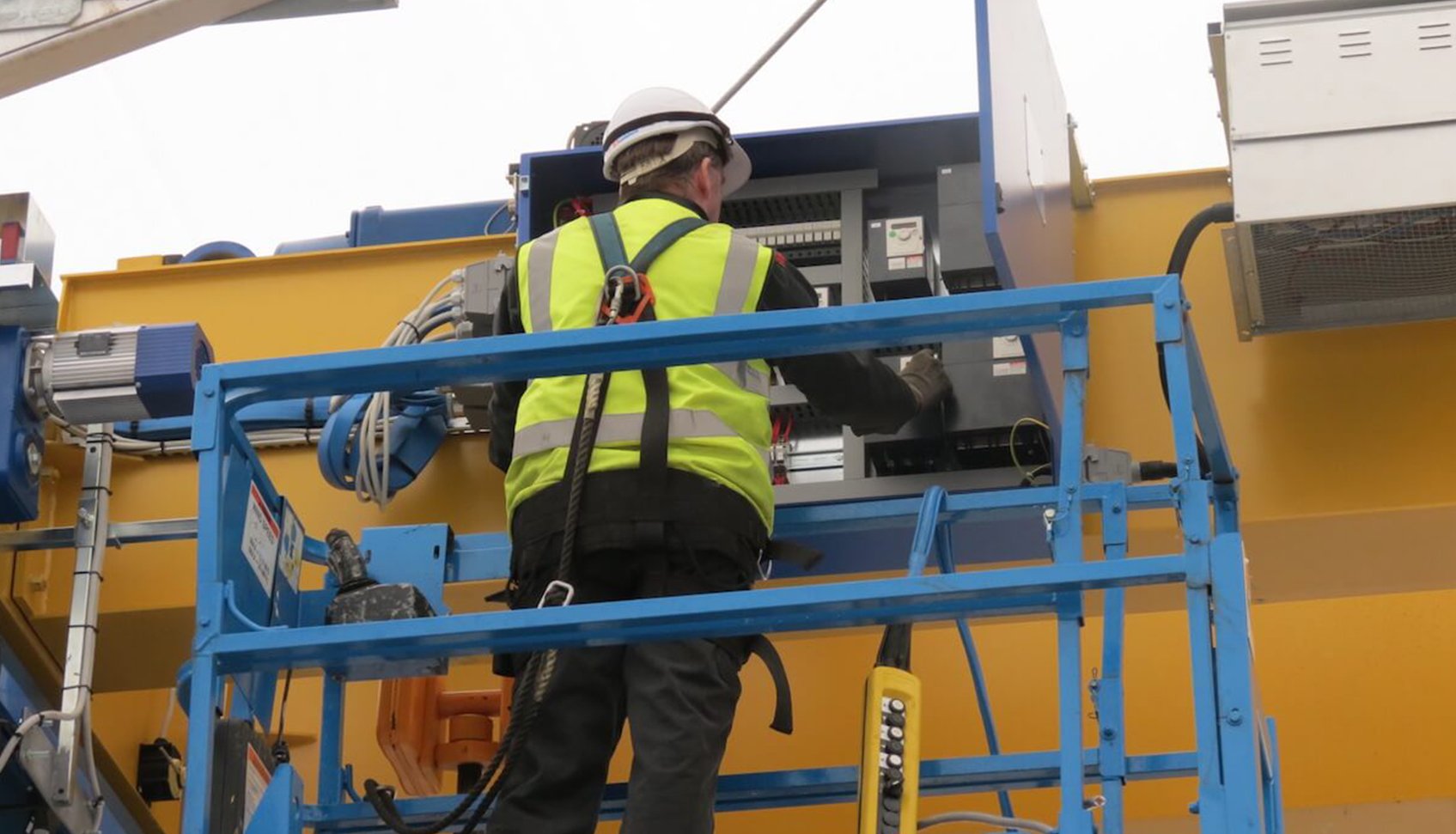
A comprehensive preventive maintenance service covers far more than a visual check. Here’s what our engineers typically inspect and maintain:
Hoist Unit
Brake adjustment, rope condition, drum inspection, gearbox oil, motor checks, limit switches
Crane Motions
Cross-travel and long-travel motors, brakes, wheels, gearboxes, drive alignment
Electrical Systems
Contactors, pendant controls, radio controls, festoon/conductor systems, isolators
Safety Devices
Overload limiter calibration, limit switches, emergency stops, warning devices
Structural Components
Bridge girders, end carriages, runway beams, supporting structure, bolted connections
Hook & Block
Hook wear and deformation, safety catch, swivel bearing, sheave condition
What Gets Lubricated
Proper lubrication is essential for crane longevity. During a service, we typically lubricate:
- Wire rope (where applicable)
- Wheel bearings
- Gearbox oil top-up or change
- Hook swivel bearing
- Guide rollers and trolley wheels
- Any grease points on the structure
The Complete Maintenance Schedule
A well-maintained crane requires attention at multiple intervals. Here’s a practical schedule:
-
Daily / Each ShiftPre-Use Operator Checks
Visual inspection of hook, rope/chain, controls, warning devices. Listen for unusual noises. Test brakes. Check the area is clear. Takes 2–5 minutes.
-
Weekly / MonthlyRoutine Inspections
More detailed visual checks by trained personnel. Inspect rope for wear, check oil levels, look for loose fixings, test all motions. Document any concerns.
-
6–12 MonthsPreventive Maintenance Service
Comprehensive service by qualified engineer. Includes lubrication, brake adjustment, electrical checks, safety device testing, and detailed inspection. Service report provided.
-
6 MonthsLifting Accessory Examination
LOLER thorough examination of all slings, chains, shackles, hooks, and below-the-hook equipment. Legal requirement.
-
12 MonthsCrane Thorough Examination
LOLER thorough examination of the complete crane system. Statutory Report of Thorough Examination issued. Legal requirement.
Daily Pre-Use Checks: What Operators Should Do
Daily checks by the crane operator are your first line of defence against problems. They take just a few minutes but can prevent accidents and catch issues early.
- Check the hook for wear, cracks, or deformation—and ensure the safety catch works
- Inspect wire rope or chain for visible damage, kinks, or bird-caging
- Test all controls function correctly (up, down, travel motions)
- Check brakes hold when tested under light load
- Listen for unusual noises during operation
- Verify warning devices (horn, lights) are working
- Check the runway and travel path are clear of obstructions
- Ensure emergency stop is accessible and functional
- Report any concerns to your supervisor immediately
If a daily check reveals any issue—unusual noise, sticking controls, rope damage, or anything else concerning – stop using the crane and report it. Don’t assume it will be fine. What seems minor can quickly become dangerous or lead to a costly breakdown.
Benefits of Regular Servicing
Beyond legal compliance, there are compelling business reasons to maintain a proper service schedule:
- Reduced downtime: Planned maintenance prevents unexpected breakdowns that halt production
- Lower repair costs: Catching problems early avoids expensive emergency repairs
- Extended lifespan: A well-maintained crane lasts significantly longer than a neglected one
- Safer operation: Regular checks catch wear before it becomes dangerous
- Insurance compliance: Many policies require evidence of regular maintenance
- Better performance: Properly adjusted brakes and drives operate more smoothly and precisely
The cost of a planned service visit is typically a fraction of an emergency callout – and nothing compared to the production losses when a crane is out of action unexpectedly.
What Happens If You Don’t Service Your Crane?
Neglecting crane maintenance doesn’t just risk breakdowns – it has serious legal and safety implications:
- HSE enforcement: The Health and Safety Executive can issue improvement notices, prohibition notices, or prosecute for LOLER/PUWER breaches
- Insurance issues: Claims may be rejected if maintenance records are inadequate
- Accelerated wear: Components wear faster without proper lubrication and adjustment
- Cascading failures: One worn component puts stress on others, causing multiple failures
- Safety incidents: Undetected defects can lead to dropped loads or crane failures
- Unexpected downtime: Breakdowns always happen at the worst possible time
We’ve seen cranes that were “fine” according to their owners need complete hoist rebuilds because worn brakes went unadjusted for years. The repair cost was 10x what regular servicing would have been – plus weeks of lost production while parts were sourced.
Granada Cranes Service Packages
We offer flexible service arrangements to suit different needs:
- Planned Preventive Maintenance (PPM): Scheduled service visits at agreed intervals, typically combined with LOLER examinations for efficiency
- LOLER Thorough Examinations: Statutory inspections by our competent engineers, with Reports of Thorough Examination issued
- Reactive Repairs: Callout service for breakdowns and urgent repairs
- 24/7 Breakdown Cover: Priority response for service contract customers
Most customers find that combining their annual service with their LOLER examination provides the best value – one visit covers both requirements, minimising disruption and cost.
Our service engineers cover the whole of the UK. Whether you need a one-off service, LOLER examination, or ongoing maintenance contract, we can help.
Or call us on 0800 376 27 27
Frequently Asked Questions
Under LOLER, overhead cranes must have a thorough examination by a competent person at least every 12 months. Lifting accessories (chains, slings, etc.) require examination every 6 months. These are legal minimums – you may need more frequent attention depending on usage.
Daily pre-use checks should be done by trained operators. However, preventive maintenance and thorough examinations must be carried out by competent persons with appropriate training and experience. For complex systems like overhead cranes, this typically means specialist crane engineers.
A LOLER thorough examination is a safety inspection that assesses whether equipment is safe to use and identifies defects. A service includes maintenance tasks – lubrication, brake adjustment, testing, and minor repairs – that keep the crane in good working order. You need both.
Costs vary depending on crane size, complexity, location, and the scope of work needed. A straightforward service on a small single-girder crane might be a few hundred pounds; larger or more complex systems cost more. We provide fixed quotes before any work begins – contact us for a specific price.
You must keep Reports of Thorough Examination until the next report is issued (or for 2 years for accessories). We recommend also keeping service reports, daily check records, and any repair documentation for the life of the equipment. These demonstrate compliance and help track the crane’s history.
Yes. LOLER requires thorough examination regardless of how often equipment is used. In fact, infrequently used cranes can develop issues from standing idle – seized brakes, corroded components, or deteriorated lubricants. A pre-use inspection is also required if the crane has been out of service for an extended period.
If a thorough examination identifies a defect that poses an immediate danger, the competent person must notify the employer and the HSE immediately. The crane cannot be used until the defect is rectified. Less urgent defects will be noted in the report with recommended timescales for repair.
Yes. Granada Cranes services all makes and models of overhead crane, not just those we’ve supplied. Our engineers are experienced with equipment from all major manufacturers and can source parts for most systems.
The advice, graphics, images, and information provided herein are for general educational and informational purposes only and are intended to promote overall safety awareness. They do not constitute legal, medical, or other professional advice or services and should not be relied upon as a substitute for consultation with suitably qualified professionals. The content is not intended to be comprehensive, and users should seek independent professional advice appropriate to their specific circumstances.