The Best Crane Setup for a Steel Fabrication Shop

Steel fabrication is demanding work. Long beams, heavy plate, structural sections – all need to be moved safely, positioned precisely, and handled dozens of times a day. The right overhead crane setup doesn’t just make this possible; it transforms your workshop’s productivity and safety.
At Granada Cranes, we’ve supplied and installed overhead crane systems for steel fabricators across the UK for over 40 years. From small structural shops running a single 5-tonne crane to large-scale fabrication facilities with multiple heavy-duty systems, we understand what works in this demanding environment.
This guide covers everything you need to know about specifying the ideal crane setup for your steel fabrication operation.
Why Steel Fabrication Needs Serious Lifting Equipment
Steel fabrication isn’t like general manufacturing. The materials are heavy, awkward, and often very long. A typical day in a fab shop might involve:
- Unloading steel deliveries from lorries
- Moving plate and sections to cutting stations
- Positioning beams for drilling, welding, and assembly
- Turning and rotating heavy assemblies
- Loading finished steelwork for dispatch
Without adequate overhead lifting, these tasks either become impossible, dangerously slow, or require multiple workers and improvised methods that increase risk. A properly specified crane system handles all of this efficiently with minimal labour.
Plate Processing
Heavy steel plate for cutting, drilling, and forming – often 3–25mm thick
Structural Sections
Universal beams, columns, channels, and angles up to 12m+ lengths
Fabricated Assemblies
Welded frames, trusses, and portal frames during and after fabrication
Loading & Dispatch
Moving finished steelwork to dispatch bays and loading onto transport
Recommended Crane Configurations
The right crane configuration depends on your typical work, building size, and budget. Here are the most common setups we install in steel fabrication shops:
Most Common
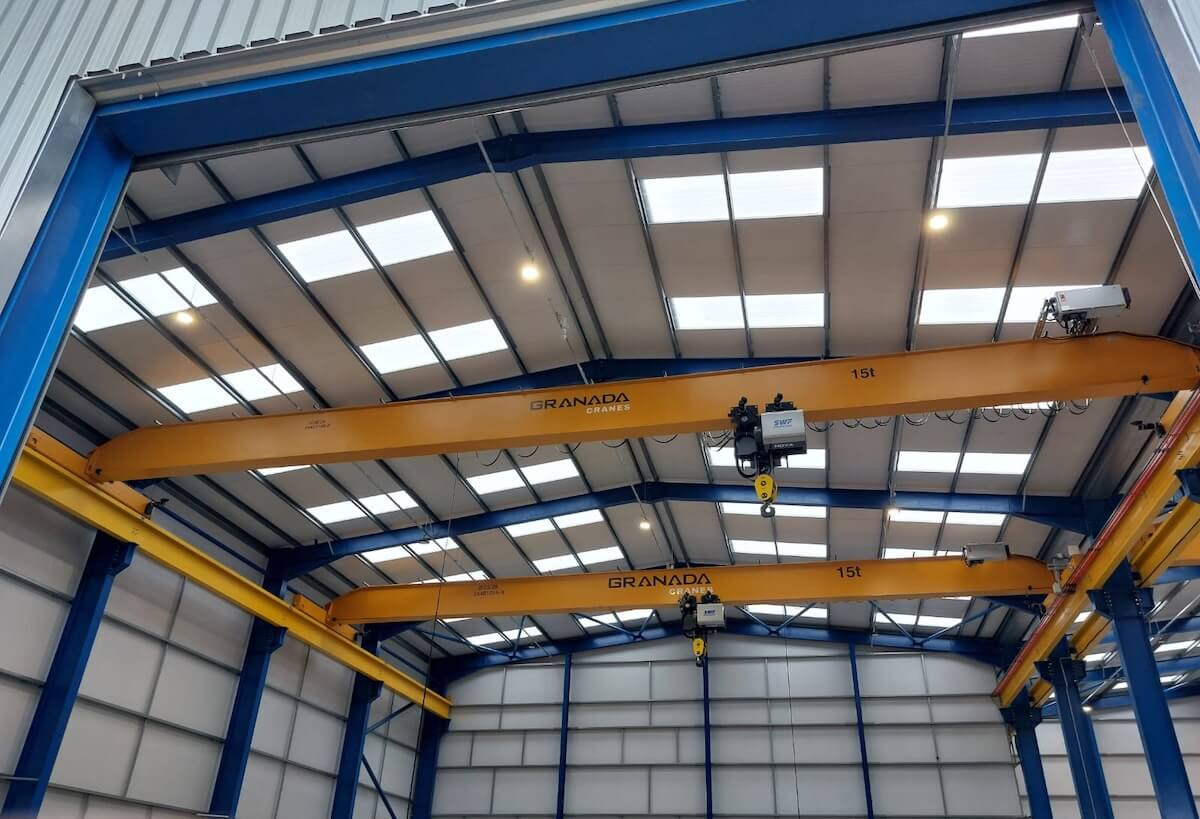
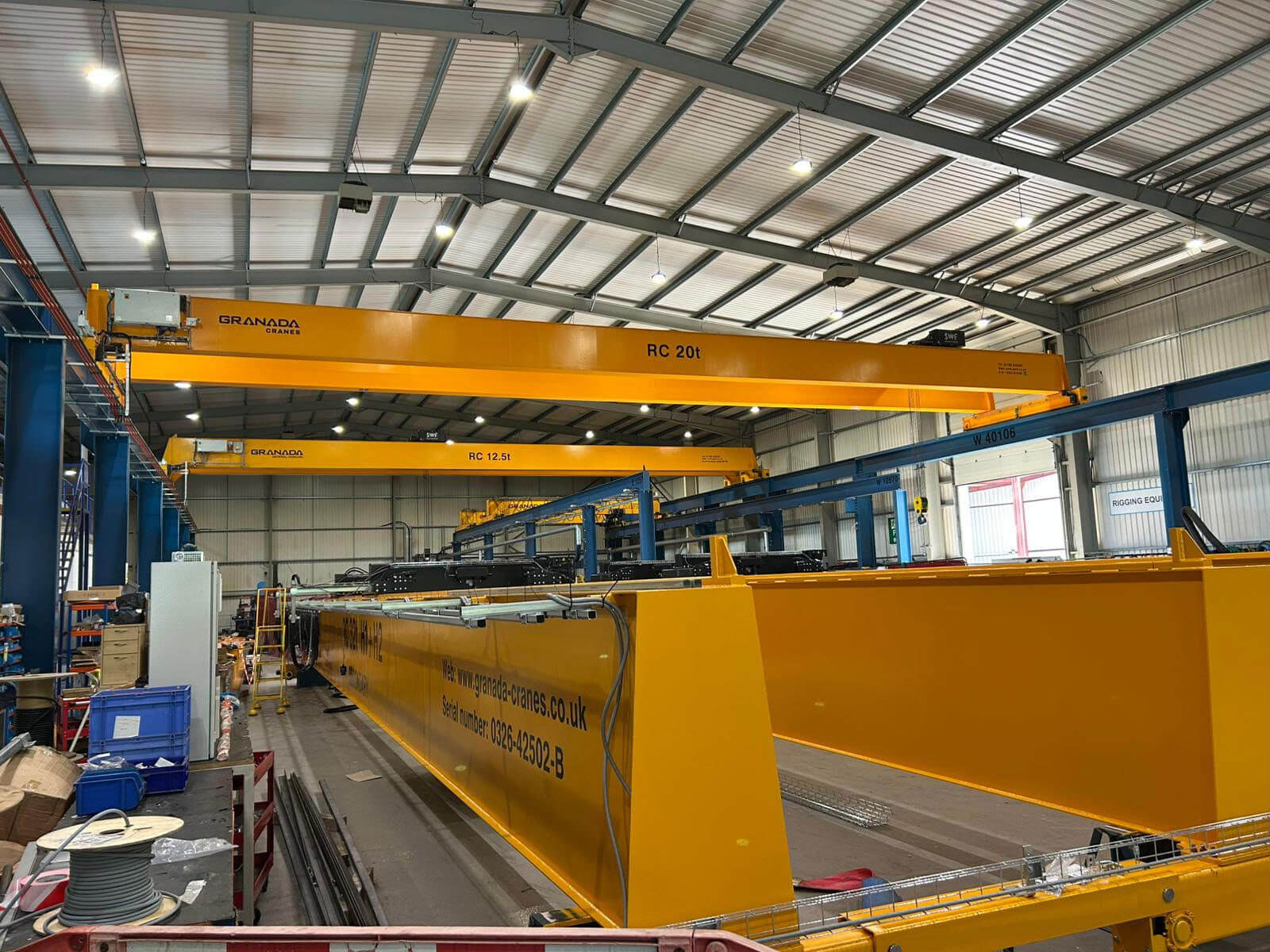
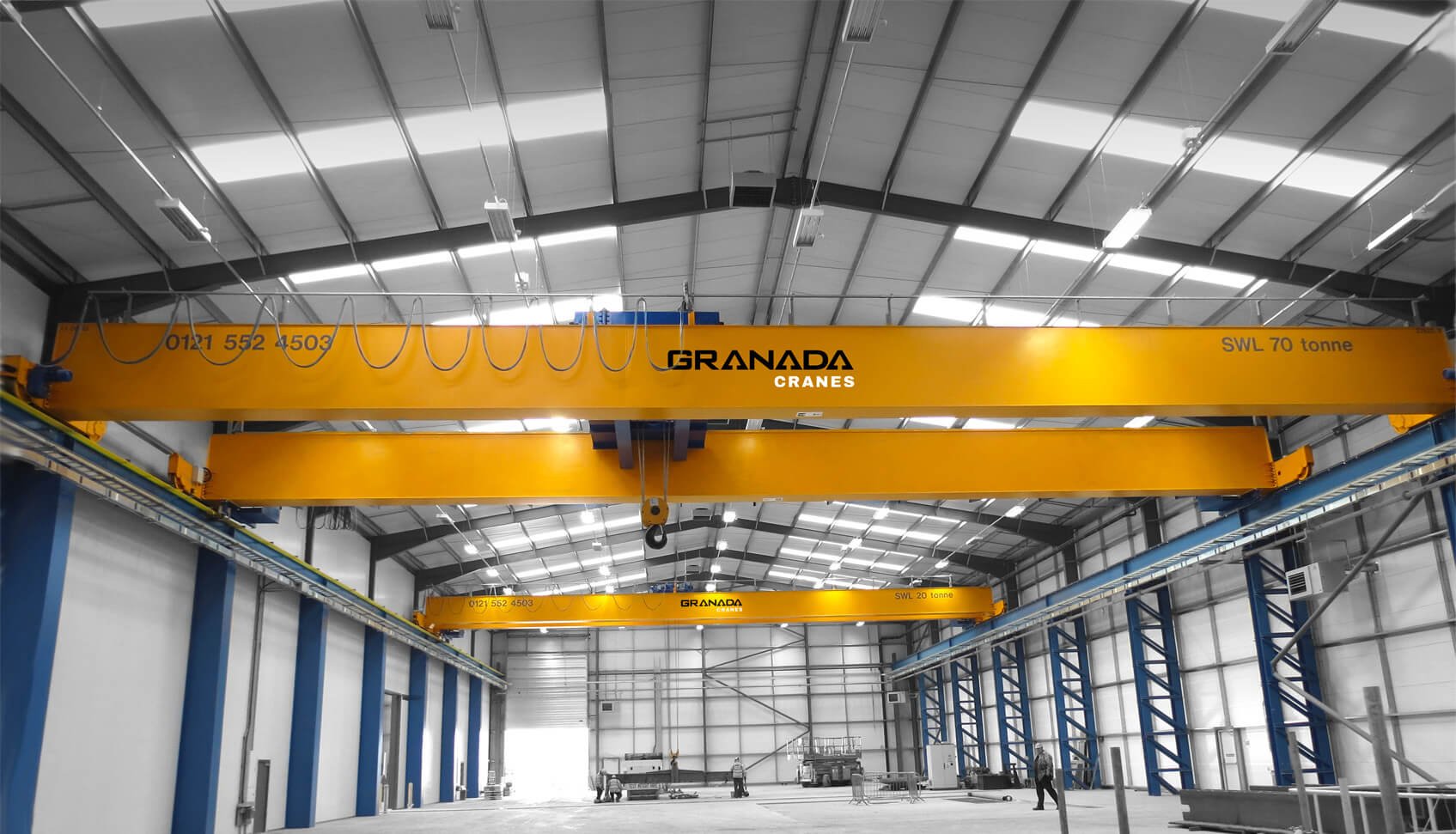
For most steel fabrication shops handling structural steelwork, a double girder overhead crane is the ideal choice. The twin-beam design provides superior strength, stability, and hook height—all critical when handling long, heavy steel sections.
Double girder cranes also allow the hoist to travel between the girders rather than underneath, maximising your usable lifting height in the building.
10–60+ tonnes
15–30+ metres
Heavy structural steel
M5–M7
For smaller fab shops or lighter work (sheet metal fabrication, light structural work, or secondary handling tasks), a single girder crane offers a cost-effective solution. These are simpler, lighter, and less expensive to install.
Single girder cranes work well for capacities up to around 10 tonnes and spans up to 20 metres, though headroom is slightly reduced compared to double girder designs.
1–12.5 tonnes
Up to 20 metres
Light-medium fab work
M4–M5
When your building structure can’t support an overhead crane, or you need coverage in an outdoor yard, a semi-goliath or goliath crane provides independent support. These cranes run on floor-mounted rails rather than building-mounted runways.
Common in steel stockholders and larger fabrication facilities with external storage areas.
5–50+ tonnes
15–40+ metres
Yards, weak buildings
M5–M6
Getting the Capacity Right
Capacity is one of the most critical decisions. Specify too low and you’ll be constantly working at the crane’s limits (or unable to lift your heaviest loads). Specify too high and you’ve wasted money on capability you don’t need.
Typical Load Weights in Steel Fabrication
To help you estimate, here are some typical weights for common steel materials:
| Material | Typical Weight | Notes |
|---|---|---|
| Steel plate (10mm × 2.5m × 6m) | ~1,200 kg | Weight increases rapidly with thickness |
| Steel plate (25mm × 2.5m × 6m) | ~2,950 kg | Common in heavy structural work |
| UB 457×191×98 (12m length) | ~1,175 kg | Common structural beam size |
| UB 610×305×238 (12m length) | ~2,850 kg | Heavy structural beam |
| UC 356×406×634 (6m length) | ~3,800 kg | Heavy column section |
| Fabricated portal frame | 2,000–8,000+ kg | Varies enormously by size |
| Plate girder assembly | 5,000–20,000+ kg | Bridge/structural work |
Capacity Recommendations by Shop Type
- Small structural/misc steel shop: 5–10 tonnes typically sufficient
- Medium fabrication facility: 10–20 tonnes covers most work
- Heavy structural/bridge fabrication: 20–50+ tonnes may be required
Remember to account for lifting accessories. If you use a 500kg magnetic beam or spreader bar, subtract that from your effective lifting capacity. A 10-tonne crane with a 500kg spreader beam can only lift 9.5 tonnes of actual steel.
Duty Cycle: Why It Matters in Fabrication
Steel fabrication typically demands a medium to heavy duty cycle. Unlike a maintenance crane that might lift occasionally, a fab shop crane operates continuously throughout the working day, often handling loads approaching its rated capacity.
For European-manufactured cranes (including those we supply from SWF Krantechnik and OMIS), duty is classified using FEM standards:
| FEM Class | Description | Suitable For |
|---|---|---|
| M4 (1Am) | Light-medium duty | Light fabrication, occasional use |
| M5 (2m) | Medium duty | General fabrication, regular use |
| M6 (3m) | Heavy duty | Intensive production, high utilisation |
| M7 (4m) | Very heavy duty | Continuous severe service (steel mills) |
Most steel fabrication shops require M5 or M6 classification. Specifying M4 when you actually need M5 will result in premature wear, more frequent breakdowns, and a shorter crane lifespan.
A crane rated for light duty (M3/M4) will fail prematurely if used in a busy fabrication environment. The motors, brakes, gearboxes, and structure are all designed for the specified duty—exceed it consistently and you’ll pay for repairs and downtime.
Essential Lifting Accessories for Steel Fabrication
The crane is only half the equation. In steel fabrication, your lifting accessories are equally important. The right below-the-hook equipment dramatically improves safety and productivity.
Plate and Section Handling
| Accessory | Application | Advantages |
|---|---|---|
| Lifting magnets | Steel plate, flat bar, sheet | Quick attach/release, no marking, handles thin plate |
| Magnetic lifting beams | Long plate, multiple sheets | Prevents plate sag, handles varying lengths |
| Vertical plate clamps | Plate stored vertically | Safe vertical-to-horizontal turning |
| Horizontal plate clamps | Plate bundles, thick plate | Secure grip on stacked material |
| Beam clamps / girder grabs | I-beams, H-sections, channels | Quick connection to structural sections |
Slings and Rigging
| Accessory | Application | Considerations |
|---|---|---|
| Chain slings (Grade 80/100) | General heavy lifting | Durable, heat resistant, adjustable |
| Wire rope slings | Heavy loads, sharp edges | High strength, good for abrasive conditions |
| Spreader beams | Long loads, balanced lifting | Prevents load tipping, distributes sling angles |
| Lifting beams (below hook) | Multiple pick points | Maintains vertical sling legs |
| Roundslings | Delicate or coated steel | Won’t mark painted/galvanised surfaces |
Permanent magnetic lifters have transformed steel handling. They attach and release instantly, leave no marks on the steel, and eliminate the rigging time associated with chains and clamps. For plate-intensive operations, a good magnetic lifting beam can dramatically increase throughput.
Workshop Layout Considerations
The best crane in the world won’t help if it can’t reach where you need it. When planning your crane coverage, consider:
- Material flow
Map how steel moves through your shop—from goods-in to cutting, drilling, welding, assembly, and dispatch. Your crane should cover this entire path, or you’ll need multiple cranes or auxiliary equipment. - Workstation positioning
Position cutting tables, drilling lines, welding bays, and assembly areas within the crane’s coverage. Consider how the crane will access each station without obstructing others. - Loading bays
Ensure the crane can reach your loading bay doors to handle incoming deliveries and outgoing dispatch. This is often overlooked and causes major headaches later. - Hook height
You need enough height to lift your longest beam vertically (for turning or manoeuvring), plus clearance above workstations and machines. Many fab shops need 8–12m hook height. - Multiple cranes
Larger shops often run two or more cranes on the same runway. This allows simultaneous operations in different areas and provides redundancy if one crane is down for maintenance.
Controls and Features for Fabrication
Modern crane controls make operation safer and more efficient. For steel fabrication, consider:
Control Options
- Radio remote control: Essential for fab shops where the operator needs to be close to the load for positioning. Allows the operator to stand in the safest position with clear visibility.
- Variable speed (VFD): Inverter-controlled drives allow smooth acceleration, deceleration, and creep speeds for precise positioning. Reduces load swing and wear on the crane.
- Tandem lift capability: If you’ll need two cranes to lift large assemblies together, ensure the controls support coordinated tandem operation.
Safety Features
- Overload protection: Prevents lifting above rated capacity—essential when load weights vary
- Anti-collision: For multiple cranes on the same runway, prevents crane-to-crane collisions
- End-of-travel limits: Prevents the crane or trolley running off the runway ends
- Load display: Shows the operator the current load weight in real time
Hoist Selection: Wire Rope vs Chain
For steel fabrication, wire rope hoists are almost always the right choice. Here’s why:
| Factor | Wire Rope Hoist | Chain Hoist |
|---|---|---|
| Capacity range | Up to 100+ tonnes | Typically up to 5 tonnes |
| Lifting height | High lifts (15m+) | Limited (usually <10m) |
| Lifting speed | Faster | Slower |
| Duty cycle | High duty (M5-M8) | Light-medium duty |
| Best for fab shops? | ✓ Yes—main crane hoists | Limited—workstation cranes only |
We typically supply SWF Krantechnik wire rope hoists or OMIS hoists for steel fabrication applications – both are designed for demanding industrial environments.
UK Compliance Requirements
Every overhead crane in a UK steel fabrication shop must comply with several key regulations:
LOLER (Lifting Operations and Lifting Equipment Regulations 1998)
All lifting equipment – including cranes, hoists, and lifting accessories – must undergo thorough examination by a competent person. For equipment used to lift people or accessories (chains, slings, clamps), this is required every 6 months. For the crane itself, examinations are typically annual unless a written scheme specifies otherwise.
PUWER (Provision and Use of Work Equipment Regulations 1998)
Requires that all work equipment is suitable for its intended use, maintained in safe condition, and used only by trained operators. This covers everything from the crane itself to the controls and safety devices.
BS 7121 (Code of Practice for Safe Use of Cranes)
Provides guidance on planning lifting operations, appointing competent persons, and safe operating procedures. If you’re carrying out complex or tandem lifts, BS 7121 is essential reading.
Granada Cranes provides full LOLER thorough examination services through our service division. We can set up a planned examination schedule to ensure your crane always remains compliant—and catch potential issues before they become problems.
Installation Considerations
Installing a crane in a steel fabrication shop involves several factors:
Building Structure
Your building must support the crane loads – both the crane’s weight and the dynamic forces when lifting and travelling. For new builds, this is designed in from the start. For existing buildings, a structural assessment determines whether reinforcement is needed.
Floor Condition
For free-standing cranes with floor-mounted columns, the concrete floor must be adequate. Our site survey identifies floor joints and assesses slab condition before specifying column positions.
Power Supply
A 10-tonne crane typically requires a three-phase electrical supply. Larger cranes need proportionally more power. We’ll advise on requirements during the quotation stage.
Installation Access
Crane components are large and heavy. We’ll need access for delivery vehicles and lifting equipment (often a mobile crane) during installation. This is planned in advance to minimise disruption to your operations.
Our team has decades of experience specifying and installing crane systems for steel fabricators across the UK. Let’s discuss your requirements.
Frequently Asked Questions
Most small to medium steel fabrication shops operate effectively with 10–15 tonne capacity cranes. Heavier structural work (bridges, large portal frames) may require 20 tonnes or more. We’d always recommend discussing your typical and maximum loads with us to ensure the right specification.
For most fab shops handling structural steel, we recommend double girder cranes. They provide better hook height, higher capacity options, and superior stability for long loads. Single girder cranes suit lighter fabrication work or where budget is a primary constraint.
Very important. Steel fabrication typically requires M5 or M6 duty classification. Under-specifying the duty cycle is a common mistake that leads to premature component failure, increased maintenance costs, and reduced crane lifespan. Always be honest about your expected usage when specifying.
If you handle significant amounts of steel plate, lifting magnets or magnetic beams can dramatically improve productivity. They attach and release in seconds, eliminate rigging time, and don’t mark the steel. For section and beam handling, beam clamps and chain slings are typically more practical.
Usually, yes. We can mount cranes to existing building steelwork (if structurally adequate) or install free-standing crane systems with independent columns. A site survey determines what’s possible and identifies any structural work required.
Sometimes this makes sense. Two cranes on the same runway allow simultaneous operations in different parts of the shop and provide redundancy. They can also work together (tandem lift) for exceptionally heavy loads. We can advise on the best configuration for your specific workflow.
Under LOLER, your crane must undergo thorough examination by a competent person at least every 12 months (or in accordance with an examination scheme). Lifting accessories like chains, slings, and clamps require examination every 6 months. You’ll receive a Report of Thorough Examination after each inspection, which must be kept on file. Granada Cranes can handle all LOLER examinations as part of a service contract.
The advice, graphics, images, and information provided herein are for general educational and informational purposes only and are intended to promote overall safety awareness. They do not constitute legal, medical, or other professional advice or services and should not be relied upon as a substitute for consultation with suitably qualified professionals. The content is not intended to be comprehensive, and users should seek independent professional advice appropriate to their specific circumstances.